
The Humanistic Gap, Part 2: Then, The Second Wave Hit
The issue isn’t AI.
The issue is that organizations are asking people to adapt again before they’ve finished integrating the last disruption. Speed was already the problem and AI just accelerated it.
We Built The Machine And Forgot Who Runs It.
Here is the core irony. We designed economic systems optimized for human behavior – purchasing, productivity, loyalty, engagement. We study consumer psychology. We A/B test the checkout experience. We know exactly what makes a human click, buy and come back.
And then we turn around and treat the humans running the machine as infinitely scalable.
Every consumer is a human; every employee is a human and every leader is a human. The nervous system doesn’t care about your Q3 targets. It responds to threat, uncertainty and overload – and right now it’s getting all three. We built an entire economic machine optimized for human behavior, interest and consumption and somewhere along the way forgot that the human running the machine has a nervous system that doesn’t scale on demand.
Machines are not selling to machines. They don’t care if you lose a customer. Do you?
AI Isn’t The Problem. The Speed Is.
Humans are predictive by nature. We build in our minds internal models of how work functions, how careers progress, what expertise is worth and what creates stability – all based on past experiences to determine how it will continue to operate. Most of the time our predictive brains update gradually as we acquire corrective or more accurate information. Over the last several years, many employees have been asked to repeatedly update their understanding of the work model itself. COVID changed where work happens. Economic uncertainty changed how secure it feels. AI is now changing assumptions about how knowledge work is performed and how human personalization matters or does not matter.
Adaptation is possible and happens every day. The challenge is not that people resist change, it’s that adaptation requires integration. Where are the strategies for meaningful change management? The current pace of expected adaptation and updating may be outpacing the attention being given to how human brains actually adapt neurologically and in meaningful ways.
Everyone is talking about AI as a technology event. Far fewer people are talking about it as a human adaptation event.
The conversation about AI has mostly focused on productivity and efficiency gains. The human experience however often includes something quieter that I don’t see or hear leaders and organizations talking about or even tracking.
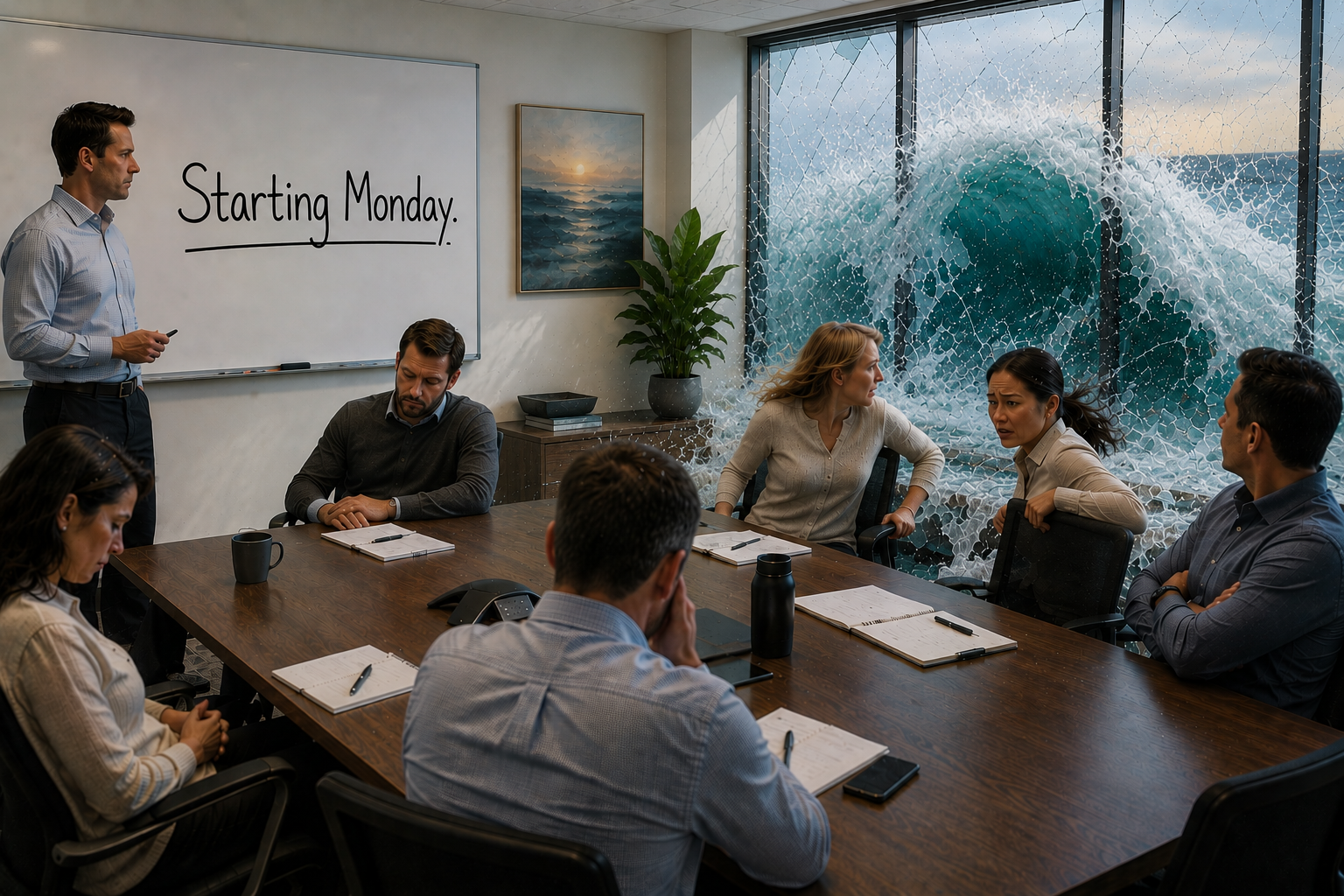
Who is gauging the impact of uncertainty about relevance, value, competence and future employability?
That experience doesn’t show up in the adoption metrics and in my work with organizations it’s usually not present in strategic and operational conversations. Why not?
I have watched organizations responding with lightning fast intensive AI training programs – three months, every employee, rotation schedules, tracked attendance and completed. Done. Everyone is “trained.” Not all organizations can afford that model. And trained to do what exactly? Those that can afford it are still left with the same unanswered question:
Did the training address the anxiety underneath the skill gap or just the skill gap that shows that you’re optically up to speed with technology?
Learning a tool and trusting what it means for your organization's impact, culture and future are very different things.
Distress Tolerance Is A Skill. Most Organizations Haven’t Built It.
Uncertainty has become a permanent condition, not a phase. The body responds accordingly – not because people are fragile, but because chronic ambient uncertainty is a nervous system event, not a strategy problem.
Distress tolerance is trainable. It is also largely absent from organizational development investment. We train people on the tools generating the uncertainty. We rarely train them on how to metabolize it. High performers are not immune to this. In my leadership experience and in my experience coaching others, I’ve seen that the most productive people on a team are often carrying the greatest unseen load. We also know that those are the ones silently taking it on and not asking for help. They dutifully carry more hoping someone will notice, hoping that someone will hold others accountable and distribute that work equally.
Some leaders are already asking these questions and noticing imbalances. They’re auditing integration time and they’re checking in with people before the metrics break. That leadership exists – and it matters that we name it, because it’s proof this isn’t idealism. It’s a choice.
The Automation Irony
We are automating the most fundamentally human businesses that are meant to connect relationally. The AI survey after the body work session or massage. The chatbot at the front desk of a customer service agency, the avatar that responds as a “Live Chat” online and the automated check-in at the doctor’s office.
Every single week I am living my life making real efforts for real needs and being caught in a loop with a different business that feels more like a gatekeeper. It feels like I’m trying to guess the right answer that a pre-programmed AI function will recognize, so that I can be let in the front door. How curious: A business that is designed to serve my human needs and yet I’m not convinced they want to serve me at all, because I can’t get a human to answer a question that the bot doesn’t know. We are missing the point people.
Efficiency has its place. When automation replaces the human moment in an inherently human transaction, we are not just cutting costs – we risk eroding the experience of being seen. People notice – even when they can’t name it.
Is anyone tracking the human experience? Who is counting the aborted attempts? There is a noticeable difference between contacting a really good provider or service and choosing to give up because I need, but can’t speak to a human.
What Leadership Silence Actually Produces
When AI strategy stays behind closed doors, employees don’t wait in neutral. Humans are story-making beings. Our brains are wired to fill the gap between what we know and what we need to know.
Without a story provided, without leaders sharing more openly, people build their own. The story that people build is almost always the predictive story they’ve always known, shaped by the worst thing that has happened before such as disappearing colleagues, disrupted safety mechanisms and decisions that arrived without warning. Leadership silence isn’t neutral. It’s a signal. Don’t think people aren’t noticing. It compounds every uncertainty already in the room.
Tips:
Before your next change initiative, ask: What is the integration plan? Speed without integration is not transformation. It’s pressure with a new name and it will compound. Are you noticing and caring for that gap?
Check your assumptions about who is struggling. High performers often don’t signal distress until something breaks. The absence of complaint is not the presence of wellbeing and resilience.
Are you strategically implementing the latest AI tool for optics in order to have the latest shiny thing, or does it honestly fit your business model, intention and purpose?
Consider This:
Leaders keep asking whether people can adapt. I keep wondering: Have people ever been given time to integrate?
Next: Part 3 of The Humanistic Gap takes a look at some critical questions to help you think about next steps.
Leading forward,
Michelle
Bridging The Gap - where insight leads to impact.
A monthly reminder that thinking requires space.
Signal vs. Noise
If there is one thing today’s workforce is not lacking, it’s input.
Emails.
Meetings.
News alerts.
Strategic priorities.
Budget pressures.
Technology updates.
Constant change.
The human brain was designed to notice signals. Yet when the volume of input becomes relentless, everything begins to feel equally important. Signal becomes noise.
This month, consider a different question: What am I treating as urgent that is simply loud?
Notice what immediately comes to mind.
Then ask: What actually deserves my attention right now?
Not next month, not next quarter, not someday.
Right now.
Clarity often doesn’t emerge from gathering more information.
Sometimes it emerges from reducing the noise long enough to hear what matters.
Be curious.
Because The Heart Of Every Great Organization Still Beats Human.®
-Michelle Ogle, Bridge Executive Coaching
ADVANCED COACHING PROGRAM
Leadership Under Pressure
• Navigating conflict without sacrificing relationships
• Understanding the human dynamics driving performance and resistance
• Strengthen influence and decision-making when the stakes are high
• Build trust, alignment and influence in complex environments

Michelle C. Ogle, M.A., Executive Coach, Organizational Consultant
Human behavior drives every organization.
For more than 30 years, Michelle has studied what captures attention, creates engagement, builds trust, influences decisions and drives behavior. As an executive coach, organizational consultant, and Possibility Strategist, she helps leaders apply those insights to strengthen relationships, align teams, and lead with greater impact.
Because The Heart Of Every Great Organization Still Beats Human.®
-Michelle Ogle, Bridge Executive Coaching