
The Shiny Object Effect: When Our Nervous System Hijacks Critical Thinking
Between the headlines, the statistic updates and the split reflections everywhere on how AI is actually landing in business, I am watching and taking notes and imagine that you are also.
We already know how to handle new technology wisely. Let someone else find the bugs, read the reviews and wait for the next version. Nobody thinks less of the person who waits for the update to stabilize – that's not just caution, that's wisdom.
So why did that wisdom weaken the moment AI showed up?
AI appeared as a strategy and became contagion. Something caught and people moved quickly because everyone else was moving – not because everyone had evaluated everything.
Every new technology has its innovation curve. This one just made the loudest splash – more celebrated, more marketed, more hyped than anything before it. When AI became visible, many jumped in before asking whether it was something they actually understood as good for them, if they wanted it and if it would bring a strong return on their investment.
Here is something to think about. Jumping in doesn't resolve the anxiety; it relocates it. Adoption didn't hand you the instant answer for how to scale and maximize your business. It lured you in and just redirected what you're anxious about.
That's impulsivity presenting as a decision.
Every business is smart to look for a force multiplier, but not at the cost of critical thinking and the strategic process you've always relied on – the one you quietly set down in the frenzy. Did the assumption of massive impact outweigh the strategic thinking that was actually reliable and customized to your organization's purpose?

The Experience, Named Honestly
I got caught up in it too.
It was visceral. I wanted to believe the ease and outcomes that all the hype promised. I let that want override my own common sense – the part of me that knows when something is engineered to encourage rather than inform. High-energy creators, vetted names, highly strategized pitches – of course it got my attention; it was designed to get my attention. I allowed my evaluation process, the one I rely on and trust everywhere else, to be subconsciously pushed aside and let the emotion lead me instead.
I pride myself on being a highly organized planner with a strong pressure tested filter. And yet, here's what I did not examine closely enough at the moment: who was doing the selling and what I was realistically hoping to walk away with. These were high performers, established leaders and experienced AI experts, who'd already made their fortune. They were promoting AI adoption at a grand scale, in a grand way, positioning it as inevitable that AI could replace human interaction across my business and my service in a way that would triple the value of my time. Maybe that's true for them, at their scale, with their resources. It was overkill for my type of business and actually, I don’t want to replace my own presence that welcomes people at my front door. Was this true for every business in that room? No. The size of the promise and the rapid fire rate at which material was being delivered, left little time to stop and challenge its consumption.
That pull is strong. I admit it, the producers are talented at marketing. Before I knew it they were setting up one upsell, then another, then a subscription – as the opportunity you don’t want to miss.
I had a healthy chuckle at myself – as one who has studied the human nervous system in the workplace for decades and now observing my own nervous system getting caught up in the hype.
One can only implement a little at a time while running a business that cannot pause without your full attention – at least not without forethought and a plan.
Where Did The Wise Mind Go?
First, a quick definition, because the phrase gets used loosely: the wise mind isn't your gut, it isn’t learned in a book and it isn't your spreadsheet. The ‘wise mind’ is the overlap where emotional impulse and intentional, mindful thought intersect and inform each other. It is important to bring both to the table. The wise mind is often the thing that goes quiet when urgency shows up disguised as a shiny opportunity.
Skepticism is not good or bad and it is not the same as cynicism. Skepticism is staying cautious, curious and gathering the facts and then making informed decisions. Remember the days when our computer operating system prompted you to update to a new version and the instinct was: let others go first, read the reviews and let them work out the bugs? I would jump in once the bugs were fixed and knew that it was stable. This falls in line with a stable and common behavioral pattern often called Roger’s Diffusion of Innovation. Where did that filter go with the AI upgrade?
Nothing in the wave of AI actually moved fast except the credit card. Evaluation didn't speed up – spending and FOMO did.
Here is something to seriously ponder: MIT Media Lab's own 2025 research shows that despite AI adoption roughly doubling since 2023, 95% of organizations studied are seeing no measurable return on their AI investment and reporting $30-$40 billion in generative AI spending. That's not a technology failure. That's what happens when spending and decisions outrun thoughtful strategy and critical thinking.
That's the contradiction that stings. The same leader who won't greenlight a hire without three interviews, who spends months on a strategic plan, who scrutinizes a vendor contract line by line is now utilizing a different strategy to adopt a new technology. Curious right? A green light on an AI framework should have earned that same scrutiny and yet it has not in many cases. This isn't proof that the discipline is missing – this is evidence that the discipline exists and was overridden.
Above And Below The Surface
On the surface, this is confirmation bias doing exactly what it's built to do. Once you want something to be the answer, your brain stops hunting for reasons it isn't. You start noticing the case study, the social media influencers and business owners with positive results. You stop noticing the colleagues who tried it and got nothing because they didn’t strategize accurate ROI. Many have not taken the time to plan governance, measurement and customized strategy. That's not incompetence – it's just what a motivated brain does. It filters in favor of the hype and the tech adoption pressure, which by the way is a real psychological phenomenon that describes the compulsive need to adopt the latest technology. Confirmation bias is leaning toward the information that matches our desire for this to finally be the answer and we quietly screen out anything that complicates the story.
Underneath the surface, it's something else: dismissing your own skepticism, abandoning the wisdom you trust everywhere else and buying into the idea that you need to get on board before it’s too late. Is that fear of missing out, fear of being left behind or competence anxiety that tells us “Am I not smart enough to see what others are seeing”? Belonging is a human need that is always running in the background; we're already predisposed to join the group. When you combine many of these named aspects together it’s easy to see how we are being pulled toward that shiny object. That human instinct is not just about your thinking mind. It happens first in your nervous system – a powerful driver of your decisions.
Here's a fact I find genuinely useful: excitement and anxiety run on the same mechanism in your brain. Same physiological signature – elevated heart rate, quickened breathing and an activated brain charged with alertness. Unless you're actively evaluating which one you are experiencing and what those sensations are telling you, they blur together and both move you in the same direction – forward and fast. Sitting still while everyone else is moving feels unbearable. That's biology doing exactly what it's built to do. The job isn't to override it – it's to notice it, name it and then decide how to make informed decisions.
So ask yourself: are you solving a problem or are you afraid of being left out of the story? When leaders override the instincts they trust everywhere else in the business, that's not a strategy failure. That's self-abandonment.
Relying On Intelligence
There's an additional drive brewing under the surface. AI stands for artificial intelligence – did we quietly decide that because it says "intelligence," we can trust that everything it generates is correct? I'm still surprised, in coaching and personal conversations, how often someone tells me a report went out the door, a process was developed, a spreadsheet created – generated, formatted, submitted – without anyone fact-checking it, stress-testing it or running it through their own organizational lens, human judgment or sense of accountability.
This is where I think we can scrutinize to make sure we are defining and solving the right problem. I am listening to discussions about AI rollout and I am hearing that most leaders are leaning primarily into technical training – how to prompt, which platform to buy and which workflow to automate. It’s all important, but the gap we are now seeing is not just technical. The gap is the wise mind that needs to pull us away from the noise and ask, “What is good for my specific business areas of application?”
Permission To Pause
Do we need to examine the beliefs driving the rush – the FOMO, tech adoption pressure, confirmation bias, the fear of looking stupid or being left behind? Do we need to design committees to look at not just governance, but budget, strategy and systems that measure different growth points?
Who is talking about the Why? Who is asking what AI application best matches the brand and customer facing image? Who is asking for feedback from the middle managers who are seeing in real time how it is rolling out and working – or not working? Who is measuring improvement markers?
We all have a taste of what is available and admittedly it’s a great tool for many purposes individually and for process improvement across many settings. But, perhaps not enough is focused on meaningful system application.
You are allowed to pause and evaluate. It's due diligence – the same due diligence you'd apply anywhere else in the business.
The MIT data already tells us most organizations haven't found that return on investment yet. Intentionally waiting for evidence is not the same as being left behind. Pausing means refusing to spend time, money and energy based on hope and hype alone.
I suggest we bring a healthy skepticism and wise mind to the AI table with us as we pause.
While I am highlighting the MIT 2025 research which is based on a wide net inclusive of AI pilot initiatives, leadership interviews and examining enterprise spending, there are many other studies reporting parallel conclusions that individual productivity is on an upward trend but not showing measurable P&L impact (Profit & Loss – revenue minus the full cost of doing business; includes software costs, consulting fees, integration work, change management, training, governance and ongoing maintenance). I won’t list additional credible research sources here, but urge you to do your own due diligence. Within the MIT report there is also a reference to the 1980 Solow Paradox from the IT-investment arena that is relevant to this conversation. I’ll put both information links at the end of this blog and I assure you that it will pique your curiosity.
Adoption Models
Let’s continue to set aside judgment and focus instead on curiosity. For those who enjoy visual frameworks, the illustrations below are not intended to persuade you what to think. They are intended to help us ask better questions. As we integrate the lessons, the story and the historical significance of these models, we position ourselves to make more informed decisions moving forward. It is never too late to make a good decision.
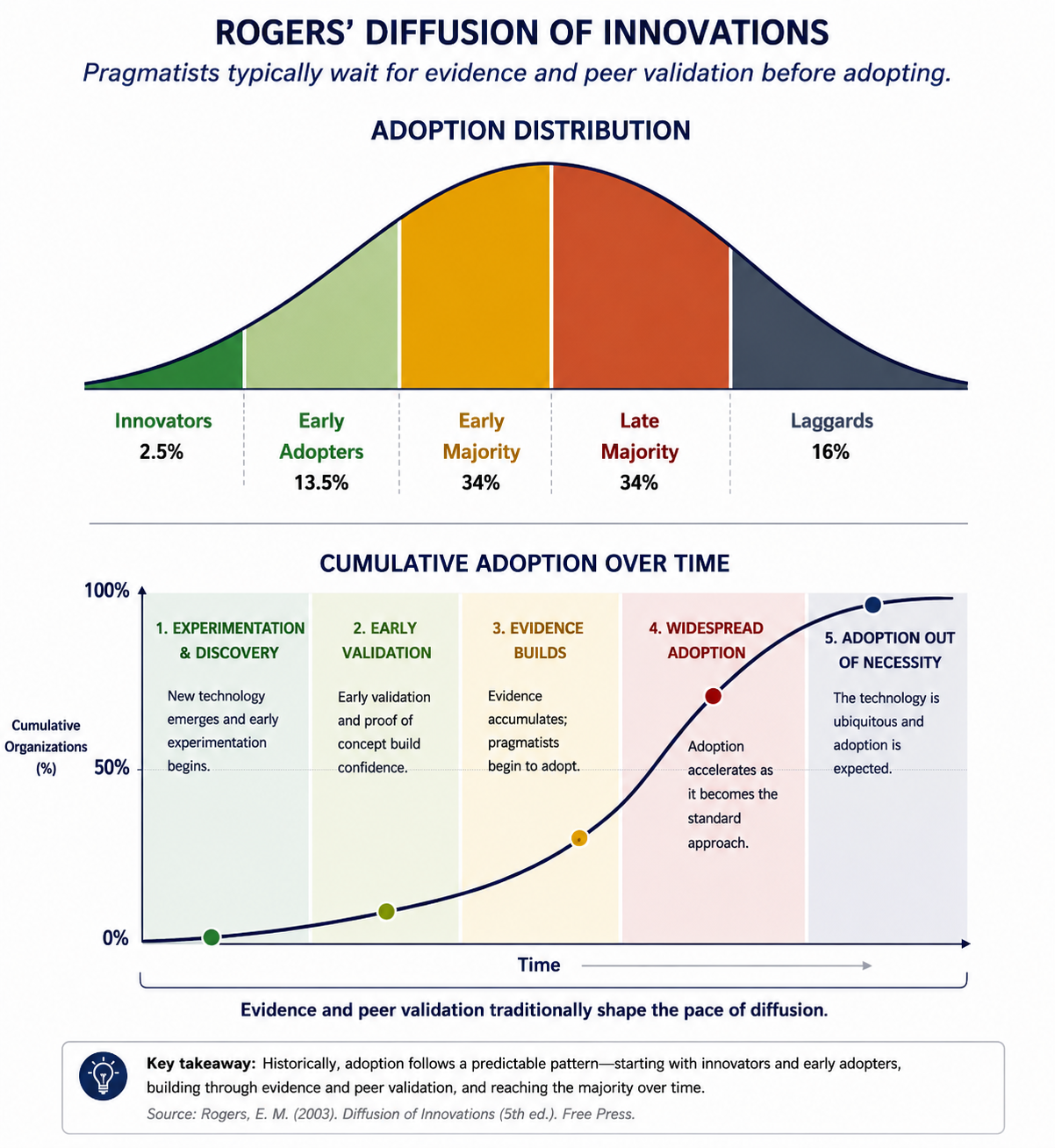
For more than sixty years, Rogers’ Diffusion of Innovations has provided one of the most influential frameworks for understanding how new technologies spread through society. Most people were not expected to be first – and that wasn’t a flaw. As mentioned earlier in the operating system example, the largest segment of adopters, the Early Majority, typically waited for evidence, peer experience and practical proof before committing. In many ways, that deliberate pause served an important purpose: it allowed enthusiasm to be filtered through experience before widespread adoption occurred.
The emergence of generative AI presents a more complicated picture.
Since the public release of ChatGPT in late 2022, organizational engagement with generative AI has accelerated at an extraordinary pace. Yet interpreting those findings is surprisingly difficult because organizations and researchers do not always mean the same thing when they use the word adoption.
Depending on the research methodology, adoption may refer to experimenting with AI, using it in at least one business function, integrating it into everyday workflows or demonstrating measurable Profit and Loss outcomes. Those are fundamentally different stages of organizational maturity, yet they are often discussed under the same label: adoption.
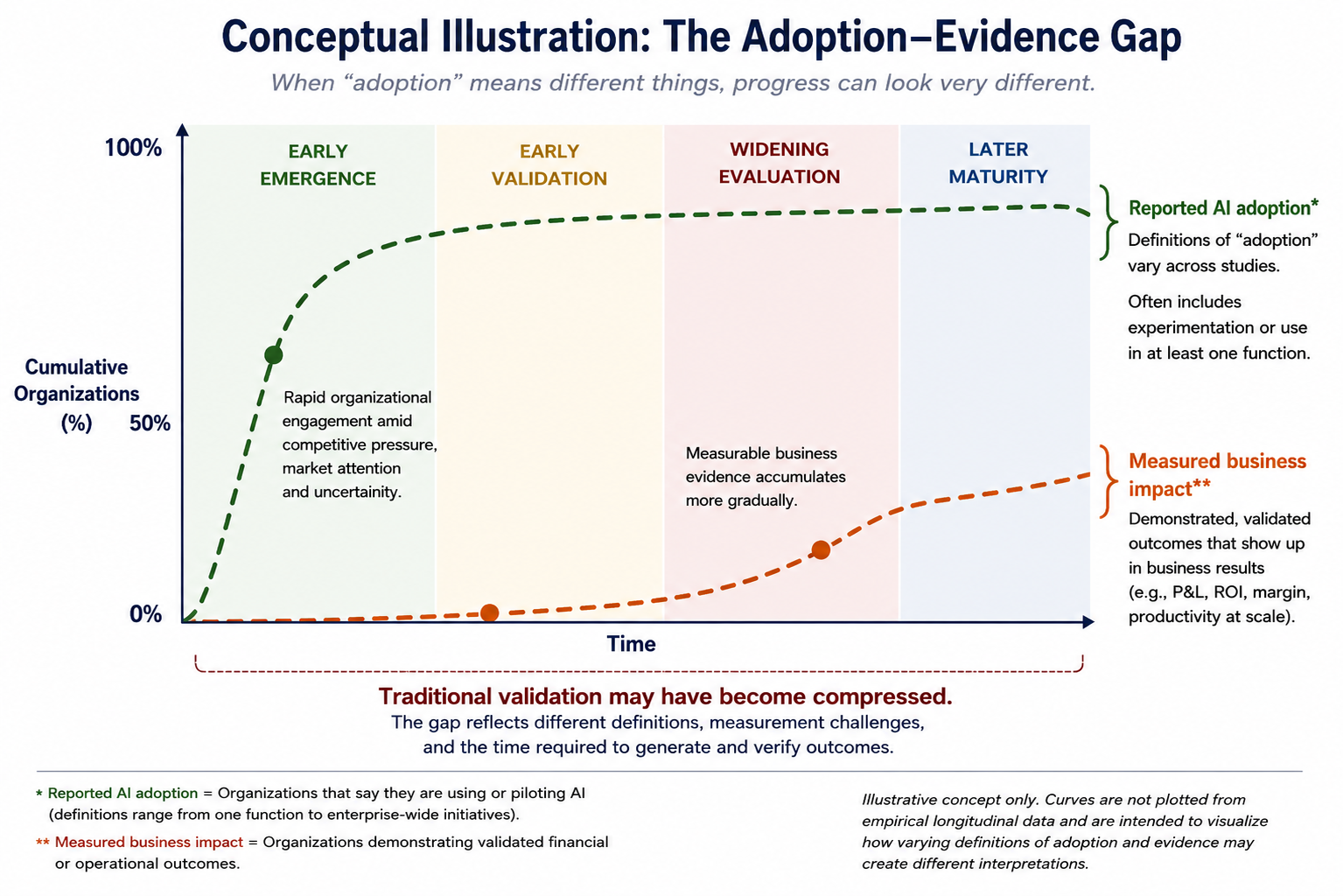
The illustration above is intentionally conceptual rather than statistical. It reflects one possible interpretation of today’s landscape: reported organizational engagement appears to have increased rapidly, while validated evidence of sustained business impact continues to emerge more gradually. Whether that interpretation ultimately proves correct will be determined over time. What it does invite us to consider is whether our traditional process of organizational validation may have become compressed as competitive pressure, technological enthusiasm and the pace of innovation accelerated.
How does this land for you and your organizational outlook?
The Caveat
These are felt experiences and observations, not conclusions. The data isn't fully in yet – and that's exactly my point. There is plenty of implicit data out there. I'm comfortable staying curious while we wait for more explicit outcomes.
And to be clear – this is not a generalization to describe everyone. There were leaders who paused, who asked the harder questions, who used the same critical thinking they always have and let strategy lead instead of hype. It’s incredible what AI has been able to accomplish for current operational systems, for those using it to explore in a stepwise manner, toward larger measurable goals and especially strategized return on investment. If that's you, this isn't your permission slip. It's confirmation you already had one.
Tips:
Ask your team what they’ve actually noticed changing day-to-day – not what leadership hoped would change.
Use your middle managers as a focus group. Are you learning how operations are actually changing or simply which AI tools people are using?
Pick one AI initiative from the last year and ask: What business problem was it intended to solve? What evidence suggests it is solving it?
Consider a small cross-functional committee dedicated to AI application and strategy – not to accelerate approvals or create unnecessary barriers, but to pressure-test assumptions, evaluate business fit and clarify success measures before significant investments are made.
Before building something new, examine what is already working. Where could existing operational workflows become more effective with AI instead of introducing an entirely new process? Incremental, measurable improvements often outperform ambitious but unproven initiatives.
Bring data governance and risk back into the conversation. Ensure employees understand what information is appropriate to share with AI systems and how to use these tools responsibly and accountably.
Give your organization permission to wait for meaningful evidence before scaling major AI initiatives. Strategic patience is not the same as organizational paralysis.
Consider This:
Next time you feel compelled to adopt before you've looked closer, pause there and notice it.
That's the moment where your wise mind wants you to pay attention. Give it permission to serve you well.
Closing Thought:
The future of AI is not the question. The question is how thoughtfully we choose to integrate it.
Are you hoping the return on investment will reveal itself after the implementation? Or, are you beginning with a clearly defined business problem, measurable success criteria and an understanding of how AI meaningfully improves the work?
This is not a decision we make once and file away. Generative AI and our thinking will continue to evolve for decades.
I certainly don’t have all the answers. My hope is simply that we resist the temptation to exchange thoughtful judgment for urgency. Curiosity, discerning pause and critical thinking have always been leadership advantages.
Perhaps the greatest competitive advantage won’t be adopting AI first. It will be knowing when to pause long enough to ask better questions.
Leading forward,
Michelle
References:
1908 Solow Paradox and Productivity paradox
Bridging The Gap – where insight leads to impact.
A monthly reminder that thinking requires space.
Signal vs. Noise
If there is one thing today’s workforce is not lacking, it’s input.
Emails.
Meetings.
News alerts.
Strategic priorities.
Budget pressures.
Technology updates.
Constant change.
The human brain was designed to notice signals. Yet when the volume of input becomes relentless, everything begins to feel equally important. Signal becomes noise.
This month, consider a different question: What am I treating as urgent that is simply loud?
Notice what immediately comes to mind.
Then ask: What actually deserves my attention right now? Right now.
Clarity often doesn’t emerge from gathering more information.
Sometimes it emerges from reducing the noise long enough to hear what matters.
Be curious.
Because The Heart Of Every Great Organization Still Beats Human.®
-Michelle Ogle, Bridge Executive Coaching
ADVANCED COACHING PROGRAM
Leadership Under Pressure
• Navigating conflict without sacrificing relationships
• Understanding the human dynamics driving performance and resistance
• Strengthen influence and decision-making when the stakes are high
• Build trust, alignment and influence in complex environments

Michelle C. Ogle, M.A., Executive Coach, Organizational Consultant
Human behavior drives every organization.
For more than 30 years, Michelle has studied what captures attention, creates engagement, builds trust, influences decisions and drives behavior. As an executive coach, organizational consultant, and Possibility Strategist, she helps leaders apply those insights to strengthen relationships, align teams, and lead with greater impact.
Because The Heart Of Every Great Organization Still Beats Human.®
-Michelle Ogle, Bridge Executive Coaching